
Last fact-verified Thu, 30 Apr 2026 against Victorian Fisheries Authority. If any bag limit, size limit, or licence requirement on this page differs from current VFA advice, VFA's current guidance takes precedence.
Quick facts
| Common name | King George Whiting |
| Scientific name | Sillaginodes punctatus |
| Also known as | KGW, Georgie, whiting |
| Bag limit | 20 per person per day |
| Minimum size limit | 27cm total length |
| Season | January to April (Port Phillip Bay) |
| Primary water | Port Phillip Bay (also Western Port) |
| Licence required | Yes. Victorian Recreational Fishing Licence required. |
Source for bag limit, size limit, and closed season: VFA species page. Last fact-verified Thu, 30 Apr 2026.
What King George whiting actually is
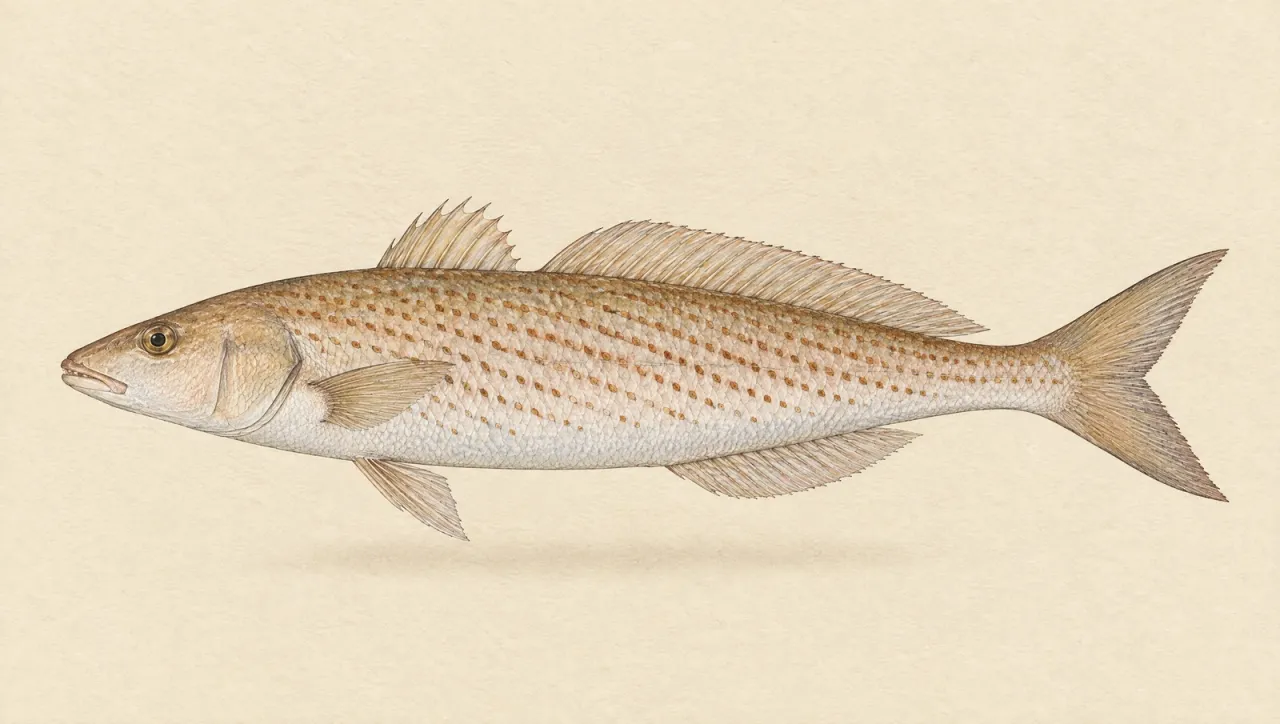
Sillaginodes punctatus is the sole species in its genus, a distinction that reflects its unique profile among Australian sillaginids. It reaches a maximum recorded length of around 72cm, though Peninsula fish in the 30 to 45cm range are the typical catch. Elongate and silver-white with faint yellow-bronze spots along the lateral line, immediately distinguishable from the smaller sand whiting (Sillago ciliata) by larger size and the spotted pattern. “KGW,” “Georgie,” and “whiting” are interchangeable in conversation along the Peninsula. “Sand whiting” always means the smaller species and should not be confused.
KGW behaviour is almost entirely governed by tidal current. In flat, current-free water, whiting settle onto the bottom and stop feeding; they are effectively uncatchable in these conditions. When tidal run is moving (particularly a rising tide with 0.5m or more of movement over two hours), the fish spread off the bottom and feed actively on invertebrates stirred by the current. On Port Phillip Bay, the optimal fishing window at most pier and sand-flat locations is the mid-tide run, not the extremes. In winter, KGW retreat to deeper water (10 to 20m) in the outer bay; in summer, they move onto the shallow sand flats from 2 to 8m depth. Seasonal migrations within the bay are well documented, with January through April consistently producing the largest fish on the Peninsula grounds.
In the kitchen, KGW is held in the same regard as flounder or John Dory. Fine white flesh with minimal oil content and exceptional eating quality. The pin bones require careful attention (a single row runs from behind the pectoral fin toward the tail), but the effort is consistently rewarded. Peninsula restaurants that source locally treat KGW as a premium product.
Season and tide
The no-run-no-fun rule. The rule on Port Phillip Bay is no run no fun. Whiting in flat, current-free water are effectively unfishable. You need tidal run, ideally a rising tide with at least 0.5m of movement over two hours, before whiting become catchable in most bay locations. This is not a rough guide; it is the governing principle of KGW fishing on the Peninsula. Planning a session around the tide chart is non-negotiable.
When to fish. The mid-tide window on a rising tide is the most reliable period at pier locations. On boat drift sessions, the two-hour window either side of mid-tide (not the peak or the slack) produces consistently. At Rye Pier and Sorrento Pier, the morning tide run (commonly 0700 to 1000 in summer, depending on the cycle) is the prime land-based window.
Western Port tides. Western Port has a more complex tidal pattern than Port Phillip; it runs a double-high-water pattern on many days, creating two brief windows of tidal run. Consult the BOM Stony Point tide predictions and Willyweather specifically for Western Port. Do not use Port Phillip predictions interchangeably.
Summer versus winter. In summer (December to March), KGW are on sand flats in 2 to 6m depth and accessible from piers. In winter, the deep-water drift (10 to 18m, mid-bay) is required to find fish; boat access and a sounder become necessary, and land-based production drops significantly.
Technique and gear
KGW are caught almost exclusively on bait rigs. Lure fishing for whiting is a niche technique on the Peninsula, not the standard approach.
- Rod. A 7-foot, 1 to 3kg graphite rod with a light-moderate action. The rod must be sensitive enough to detect the subtle pick-up of a whiting feeding on a stationary bait.
- Reel. A 2500 to 3000 size fixed spool with 6 to 8lb monofilament mainline or 10lb braid, plus a 6 to 8lb monofilament or fluorocarbon leader of 60 to 80cm. Lighter leaders outperform heavier in the clear Port Phillip water.
- Rig. The paternoster is canonical for KGW: two 30 to 40cm droppers above the sinker, size 4 to 6 long-shank or Limerick hooks, running sinker of 15 to 30g depending on current strength. The rig sits the bait just off the bottom, in the feeding zone.
- Sinker weight. Match weight to current strength. Too heavy and the bait sits dead; too light and it drags uncontrolled. On a strong mid-tide run at Rye Pier, 25 to 30g is typically required to hold.
Bait
Bass yabbies (Trypaea australiensis) are the premier KGW bait on Port Phillip Bay. Their natural abundance in the bay’s sandy flats means whiting are conditioned to them throughout their life cycle. A live or fresh-dead yabby on a size 4 to 6 long-shank hook, tail-hooked through the last segment, is the standard presentation.
Pipis (Donax deltoides) are the most widely available alternative. Crack the shell, extract the soft body whole, and thread it onto the hook without obscuring the point. Pipis have an advantage in durability; they stay on the hook longer than yabby bodies in current.
Bass yabbies can be pumped from sandbars at low tide with a yabby pump. Local tackle stores stock them during peak season. Pipis are available year-round. Do not use salted or frozen yabbies as a substitute; whiting distinguish fresh bait from preserved bait reliably.
Bag and size limits, licence
- Minimum size limit. 27cm total length.
- Bag limit. 20 per person per day.
- No-fillet rule. Cannot be filleted in or on Victorian waters; keep whole or in carcass form until away from the water. Filleting at boat-ramp cleaning tables is permitted.
- Season. Open year-round.
- Licence. A Victorian Recreational Fishing Licence is required for anglers aged 18 and over. Charter exemptions apply; confirm with the operator.
Source: Victorian Fisheries Authority. Last fact-verified Thu, 30 Apr 2026.
Opportunity ranking by location
- Rye Pier, paternoster, pipis or bass yabby, January to April, rising tide. The canonical land-based KGW location on Port Phillip Bay. Consistent results when the tide is running. Weekend crowds are significant; arrive before 0630 or target weekday sessions. The pier’s 450m-plus length and the clean sandy bottom beyond the pier head provide the classic whiting habitat.
- Port Phillip Bay drift, mid-bay (4 to 8m sand), paternoster, bass yabby, December to March. Productive for larger fish but requires a vessel and a sounder to locate sand-over-shell patches. Best guided by a local charter skipper on a first visit; the ground is unmarked and requires local knowledge.
- Sorrento Pier, paternoster, pipis, November to April, mid-tide. Reliable summer KGW from the pier with sheltered access and a nearby car park. The sand flat extending northeast from the pier head is the prime zone.
- Western Port (Hastings to Tooradin), boat drift, deep paternoster, May to September, moving tide. When Port Phillip fish are in deep water or absent, Western Port’s tidal run keeps whiting active in the deeper channels. Best from Hastings Boat Ramp on a day with two usable tide cycles.
Where to catch king george whiting on the Peninsula
- Hastings Jetty · Western Port · October to March (snapper); November to March (whiting); year-round (flathead, bream)
- Mornington Pier · Port Phillip Bay · October to April for snapper; year-round for squid
- Rye Pier · Port Phillip Bay · November to March (whiting); April to June and September to November (squid peaks)
- Cowes Jetty · Western Port · October to March (snapper); November to March (whiting)
- Flinders Pier · Bass Strait fringe · April to July (squid peak); November to March (whiting)
- Safety Beach Foreshore · Port Phillip Bay · November to March (whiting and garfish); year-round (squid)
- San Remo Jetty · Western Port · October to March (snapper); November to March (whiting); year-round (squid)
- Stony Point Pier · Western Port · October to December (snapper); October to March (whiting); March to June (squid)
Charter operators that target king george whiting
- I'm Hooked Fishing Charters · Licence covered
- Reel Time Fishing Charters
- Western Port Fishing Charters
Operators are listed because they demonstrably target king george whiting, not as a default reference. Browse all Peninsula charters to compare across species and seasons.
Where to cook your catch
Frequently asked questions
When is the best time to fish for King George whiting on the Peninsula?
January through April is the peak window in Port Phillip Bay; warmer water has the fish on the shallow sand flats and feeding actively. Western Port runs slightly differently; the stronger tidal exchange keeps whiting catchable through winter when Port Phillip fish retreat to deeper water. Always plan around tidal run; no run no fun.
What is the bag and size limit for King George whiting in Victoria?
Twenty per person per day. Minimum size is 27cm total length. Open year-round, no closed season. KGW cannot be filleted in or on Victorian waters; fish must be kept whole or in carcass form until away from the water. Source: VFA. Confirm before fishing.
What is the no-run-no-fun rule?
Whiting are governed almost entirely by tidal current. In flat, current-free water they settle on the bottom and stop feeding actively. When the tide is running (ideally a rising tide with at least 0.5m of movement over two hours), the fish lift off the bottom and feed on the invertebrates the current stirs up. The rule is not a guideline; it is the governing principle of KGW fishing on Port Phillip Bay.
What is the best bait for King George whiting?
Bass yabbies are the premier bait. The natural abundance of yabbies in the bay's sandy flats means whiting are conditioned to them throughout their life cycle. A live or fresh-dead yabby tail-hooked through the last segment on a size 4 to 6 long-shank hook is the standard presentation. Pipis are the most widely available alternative; they outlast yabbies on the hook in current.
Can I catch King George whiting on lures?
Possible but a niche approach on the Peninsula. Whiting are caught almost exclusively on bait rigs (paternoster with bass yabby or pipi). Soft plastics work occasionally for larger fish in shallow sand-flat conditions, but bait is the standard and the productive method.
Verified stamp
Key facts last verified Thu, 30 Apr 2026 against the Victorian Fisheries Authority. If any bag limit, size limit, or licence requirement on this page differs from VFA's current guidance, VFA's current guidance takes precedence. Regulations change. Confirm before fishing.